Once a Car Has Used Synthetic Oil Can It Use Regular Oil Ever Again
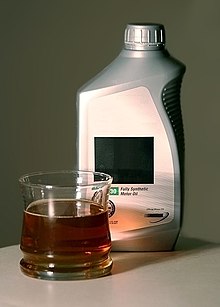
A sample of synthetic motor oil
Constructed oil is a lubricant consisting of chemical compounds that are artificially made. Synthetic lubricants tin can exist manufactured using chemically modified petroleum components rather than whole crude oil, merely tin can also be synthesized from other raw materials. The base textile, even so, is still overwhelmingly crude oil that is distilled so modified physically and chemically. The actual synthesis process and composition of additives is generally a commercial trade secret and will vary amid producers.[1]
Synthetic oil is used as a substitute for petroleum-refined oils when operating in extreme temperature.[ii] Shipping jet engines, for example, require the use of synthetic oils, whereas shipping piston engines do not.[three] Synthetic oils are also used in metal stamping to provide environmental and other benefits when compared to conventional petroleum and animal-fat based products.[4] These products are besides referred to equally "non-oil" or "oil free".
Types [edit]
Full [edit]
Some "synthetic" oil is fabricated from Group Three base stock, some from Group IV. Some from a blend of the two. Mobil sued Castrol and Castrol prevailed in showing that their Group Three base of operations stock oil was inverse enough that information technology qualified as full synthetic. Since and so API has removed all references to Synthetic in their documentation regarding standards. "Total synthetic" is a marketing term and is not a measurable quality.
Grouping IV: PAO [edit]
Poly-alpha-olefin (poly-α-olefin, PAO) is a not-polar polymer made by polymerizing an blastoff-olefin. They are designated at API Group IV and are a 100% synthetic chemical compound. It is a specific type of olefin (organic) that is used equally a base stock in the production of some constructed lubricants. An alpha-olefin (or α-olefin) is an alkene where the carbon-carbon double bond starts at the α-carbon atom, i.e. the double bond is between the #i and #2 carbons in the molecule.[v]
Grouping Five: Other Synthetics [edit]
Grouping V base oils are divers past API as any other blazon of oil other than mineral oils or PAO lubricants.
Esters are the well-nigh famous synthetics in Grouping 5, which are 100% synthetic chemic compounds consisting of a carbonyl adjacent to an ether linkage. They are derived by reacting an oxoacid with a hydroxyl compound such equally an booze or phenol. Esters are unremarkably derived from an inorganic acrid or organic acid in which at least 1 -OH (hydroxyl) group is replaced past an -O-alkyl (alkoxy) group, most usually from carboxylic acids and alcohols. That is to say, esters are formed past condensing an acid with an alcohol.
Many chemically dissimilar "esters" due to their polarity and unremarkably excellent lubricity are used for various reasons every bit either "additives" or "base stocks" for lubricants. [v]
Polyalkylene Glycol (PAG) Synthetic Oil [edit]
Industrial PAG [edit]
The terms polyalkylene glycol and polyglycol are used interchangeably.[half-dozen]
Synthetic lubricants are most four% of the lubricants market. PAGs are almost 24% of the constructed lubricants market place.
Ethylene is the basic raw material used to make the synthetic lubricant polyglycols oils. When ethylene and propylene react with oxygen nosotros obtain ethylene oxide and propylene oxide, from which the polyalkylene glycols are produced past means of polymerization. Polyalkylene glycols are unremarkably fabricated by combining ethylene oxide (EO) and/or propylene oxide (PO) with an alcohol or h2o.
The mixing ratio between EO and PO, plus the oxygen bonded in the chemic structure, crucially affect the behavior of polyglycols. The gear industry predominantly uses polyglycols with an EO/PO ratio of 50:50 to 60:forty, which exhibit very similar behavior. The polyglycols featuring this composition are also more often than not referred to as water soluble polyglycols.[seven]
Polyalkylene glycol base of operations oils are formed by reacting an alcohol with one or more than alkylene oxides: Propylene oxide provides h2o insolubility, Ethylene oxide provides water solubility.
PAG Backdrop [edit]
PAGs offering properties that include: high lubricity, polarity, depression traction properties, high viscosity alphabetize, controlled quenching speeds, proficient temperature stability and low wear. They are available in both water soluble and insoluble forms.[viii]
PAG Uses [edit]
PAGs are commonly used in quenching fluids, metalworking fluids, gear oils, chain oils, food-grade lubricants and as lubricants in HFC type hydraulics and gas compressor equipment. [ix] PAG lubricants are used by the two largest U.Due south. air compressor OEMs in rotary screw air compressors.[10] PAG oils of different viscosity grades (unremarkably either ISO VG 46 or ISO VG 100) are often used equally compressor lubricants for automotive air conditioning systems employing low GWP refrigerants.
PAG Advantages [edit]
PAGs are available in a broad range of viscosity grades and additive packages for a variety of uses. Some PAGs properties such equally water solubility are not commonly provided past other synthetic lubricants, such every bit polyalphaolefins (PAO).
PAGs forbid sludge and varnish from developing at loftier temperatures. PAGs have viscosity indexes that are college than PAOs.[xi] [12] [13]
In large gears, PAG lubricant yielded lower friction than PAO lubricant.[xiv]
PAG oils are polar, which means that an oil movie hands develops upon all moving metal parts, reducing startup clothing.
PAGs tin can be highly biodegradable, especially the water soluble PAGs.[15]
Pags perform improve than in extreme weather status. [16]
PAG Disadvantages [edit]
PAGs are not compatible with mineral oils, near seals, paints, varnishes.[17] [18]
Constructed oil is way expensive than mineral oils. [19]
PAG Seal compatibility [edit]
PAG is usually compatible with FKM fluoroelastomer materials and VMQ (vinyl methyl silicone) Silicone rubber.
PAG acts as a solvent and dissolves and removes the mineral grease which causes slower motions, air leaks, and can terminate four-way valves from operating.[xx] [21]
Natural safety, Buna-N, and most regular seals are incompatible with PAG oils, especially seals coated in mineral grease. PAG oils can cause seals to shrink or keen, thus causing severe leakage or seizure of the seal. Pneumatic air cylinders and 4-ways valves unremarkably use Buna-N safe seals that coated in mineral grease.[22]
Semi-synthetic oil [edit]
Semi-synthetic oils (besides called "synthetic blends") are a mixture of mineral oil and synthetic oil, which are engineered to take many of the benefits of full synthetic oil without the cost. Motul introduced the offset semi-constructed motor oil in 1966.[23]
Lubricants that have constructed base stocks even lower than 30% but with high-performance additives consisting of esters can as well be considered synthetic lubricants. In full general, the ratio of the constructed base stock is used to define commodity codes among the customs declarations for tax purposes.
Other base stocks assistance semi-constructed lubricants [edit]
API Group 2- and API Group Iii-blazon base stocks help to formulate more economic-type semi-synthetic lubricants. API Group I-, II-, Ii+-, and Three-blazon mineral-base oil stocks are widely used in combination with additive packages, performance packages, and ester and/or API Group IV poly-alpha-olefins in order to formulate semi-synthetic-based lubricants. API Group III base oils are sometimes considered fully constructed, but they are still classified as highest-tiptop-level mineral-base stocks. A synthetic or synthesized fabric is i that is produced past combining or edifice private units into a unified entity. Synthetic base of operations stocks as described above are man-fabricated and tailored to have a controlled molecular structure with predictable properties, unlike mineral base of operations oils, which are complex mixtures of naturally occurring hydrocarbons and paraffins.[24] [25]
Functioning of synthetic oil [edit]
The advantages of using constructed motor oils include better depression- and high-temperature viscosity performance at service temperature extremes[26] amend (higher) Viscosity Alphabetize (VI)[27] and chemical and shear stability. [28] This too helps in decreasing the loss due to evaporation.[27] [29] [30] [31] Information technology serves resistance to oxidation, thermal breakdown, and oil sludge problems[32] and extended drain intervals, with the environmental benefit of less used oil waste material generated. It provides better lubrication in extreme common cold conditions.[27] The apply of constructed oils promises possibly a longer engine life[27] with superior protection confronting "ash" and other deposit formation in engine hot spots (in particular in turbochargers and superchargers) for less oil burn down-off and reduced chances of damaging oil passageway clogging.[26] The performance of automobiles is improved as net increase in horsepower and torque due to less internal drag on engine.[32] Moreover, it tin can amend fuel efficiency - 1.8% to 5% has been documented in fleet tests.[27] Research suggests that synthetics performed about 47% better than regular oil.[33]
Still, synthetic motor oils are substantially more than expensive (per volume) than mineral oils[34] and have potential decomposition issues in certain chemical environments (predominantly in industrial use).[35]
See also [edit]
- PTT Public Company Express
- Total S.A.
- Amsoil
- Castrol
- ENEOS
- ENOC
- Fischer–Tropsch process
- Idemitsu Kosan
- Liqui Moly
- Mobil 1
- Valvoline
- Shell
- Fuchs Petrolub
- Motul
- Pennzoil
- Petro-Canada
- Quaker State
- Carmine Line Oil
- Royal Regal
- Schaeffer Oil
- Silver Country
- Synthetic fuel
References [edit]
- ^ "How Constructed Oil is Made". napaonline.com. 2016-eleven-28.
- ^ Machinery Lubrication. "Conventional vs Constructed Oil". Archived from the original on 2010-04-06. Retrieved 2017-03-24 .
- ^ "Constructed oil: Is information technology right for your plane?". Full general Aviation News. 2005-03-11. Retrieved 2017-03-24 .
- ^ "Metal Stamping FAQs". Keats Manufacturing Co . Retrieved 2017-03-24 .
- ^ a b SynLube Incorporated. [1] All Most Synthetic Oil
- ^ Polyalkylene Glycol Synthetic PAG Oil Explained | Daryl Beatty, Dow Chemical Visitor and Martin Greaves, Dow Chemical Company
- ^ Klueber | White Newspaper Polyglycol-based Oils
- ^ Croda Lubricants | Polyalkylene glycol base oils
- ^ Croda Lubricants | Polyalkylene glycol base oils
- ^ Polyalkylene Glycol Synthetic PAG Oil Explained | Daryl Beatty, Dow Chemic Company and Martin Greaves, Dow Chemic Visitor
- ^ Agreement Polyalkylene glycol | Wil Escobar | Tribiology and Lubrication Technology | May 2008
- ^ United states Environmental Protection Bureau | Environmentally Acceptable Lubricants | two.iii POLYALKYLENE GLYCOLS (page 5)
- ^ EPA | Data Licensing Information for the U.Due south. Environmental Protection Agency | Unless otherwise specified, all data produced by the U.South EPA is by default in the public domain and is not subject to domestic copyright protection nether 17 U.Due south.C. § 105.
- ^ [https://www.klueber.com/blog/usa-canada/download/alkt68mKhbrn8it1lxCKsLn62U6oK6dEg7hu-Kozsr0, Klueber | White Paper Polyglycol-based Oils]
- ^ EPA Environmentally Acceptable Lubricants
- ^ The Benefits of Switching to Synthetic Motor Oil
- ^ United States Environmental Protection Agency | Environmentally Acceptable Lubricants | 3.4 ADVANTAGES AND DISADVANTAGES OF POLYALKYLENE GLYCOL-BASED EALS (page 8)
- ^ Polyalkylene Glycol Synthetic PAG Oil Explained | Daryl Beatty, Dow Chemical Visitor and Martin Greaves, Dow Chemical Company
- ^ Consumers Study Should You Use Synthetic Oil in Your Automobile?
- ^ Mobil Glygoyle™ Series | Polyalkylene Glycol (PAG) Gear, Bearing and Compressor Lubricant
- ^ New Equipment Digest | Benefits of Using PAG (Polyalkylene Glycol) Based Lubricants
- ^ Modern Machinery | Polyalkylene Glycol Constructed PAG Oil Explained
- ^ DELPHI history
- ^ ASTM Fuels & Lubricants Handbook, Hydrocarbon Chemistry, pg 169-184, section 7
- ^ Wills, J. George (of Mobil Oil Corporation) (1980). Lubrication Fundamentals. Thou. Dekker. ISBN9780824769765.
- ^ a b "Synthetic oil vs. conventional oil | Mobil™ Motor Oils". mobiloil.com . Retrieved 2017-03-24 .
- ^ a b c d e "Synthetic Motor Oil - GM High Tech Performance Magazine". Super Chevy. 2002-01-01. Retrieved 2017-03-24 .
- ^ Markova, Fifty. V.; Makarenko, V. 1000.; Kong, H.; Han, H. -M. (2014). "Influence of viscosity modifiers on the rheological properties of synthetic oils". Journal of Friction and Wear. 35 (5): 351–358. doi:x.3103/S1068366614050092. S2CID 110320631.
- ^ Synthetic verus Mineral Fluids in Lubrication | A. Jackson | Mobil Research and Development Corporation | December 1987 | Page 7 Figure 5. Comparison of the volatility (ASTM D1160) of polydecene and mineral-based SAE 10W-thirty oils.
- ^ Evolution and Awarding of a Lubricant Composition Model to Written report Furnishings of Oil Transport, Vaporization, Fuel Dilution, and Soot Contamination on Lubricant Rheology and Engine Friction past Grace Xiang Gu B.Southward., Mechanical Engineering science University of Michigan, 2012 | Page 96 … due to loftier temperatures nearly the top dead center of the piston, lite volatile hydrocarbons vaporize and leave the organisation. Light carbon number species disappear at a faster rate due to their high volatility and vaporization rates. | Page 64 Effigy five-four: Viscosity curve for two different grades of oil using the Walther's formula | Folio 68 Effigy v-five: Oil species humid point and molecular weight.
- ^ Oilap [ permanent expressionless link ]
- ^ a b "Why Utilize Premium Synthetic Motor Oil? Premium Synthetic Oil vs. Standard Oil". Royal Majestic . Retrieved 2017-03-24 .
- ^ AAA study
- ^ "Synthetic Vs. Mineral Motor Oil". Hot Rod Network. 2002-08-01. Retrieved 2017-03-24 .
- ^ "The Disadvantages of Using Synthetic Motor Oil". Information technology Still Runs . Retrieved 2019-07-02 .
Source: https://en.wikipedia.org/wiki/Synthetic_oil
0 Response to "Once a Car Has Used Synthetic Oil Can It Use Regular Oil Ever Again"
Post a Comment